
Imagine standing on the shoulder of Route 17 or the Garden State Parkway after a severe highway collision. Your hybrid or electric vehicle (EV) is crumpled, the airbags are deployed, and a heavy, uneasy silence fills the air. If you were driving a gas-powered car, you would worry about leaking fluids or smoke from the radiator. But with an EV, an entirely different type of anxiety takes over: the terrifying fear of a volatile lithium-ion battery fire.
That fear is completely valid. When an advanced powertrain is compromised in a crash, it does not behave like a standard internal combustion engine. The massive battery packs running along the undercarriage house immense electrical energy that can fail violently if structurally deformed.
Securing hybrid/EV crash sites requires a radically different, highly disciplined safety protocol. Treating an EV like a conventional automobile can lead to catastrophic electrical shocks or uncontainable chemical blazes. At Polina Transporter LLC, we provide specialized emergency road service across New Jersey, deploying certified accident towing recovery professionals trained to stabilize high-voltage systems right at the scene. Here is exactly what happens behind the scenes to eliminate battery fire risks and ensure your total safety.
The Anatomy of an EV Battery Hazard
To understand how to safely secure an accident scene, you must understand what happens inside a compromised battery pack during a high-impact collision. Modern electric vehicles utilize massive traction batteries that operate at voltages ranging from 400V to over 800V. This represents an enormous amount of “stranded energy”, electrical power trapped inside a damaged structure with no safe way to escape.
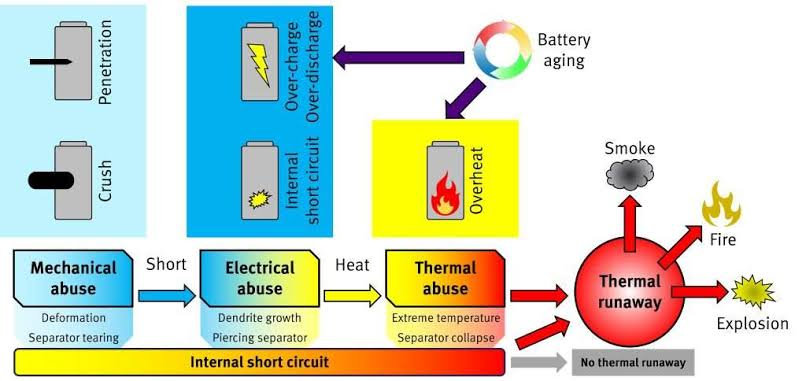
When a collision causes severe structural deformation, the physical force can crush the battery’s protective metal housing. This punctures the microscopic separator layers inside the individual lithium-ion cells, triggering an immediate internal short circuit.
When a cell short-circuits, it converts its stored chemical energy directly into intense, localized heat. If that heat crosses a critical threshold, it triggers a chain reaction known as thermal runaway. The failing cell bursts, releasing flammable, toxic off-gasses (including hydrogen fluoride and carbon monoxide) while spreading extreme heat to adjacent cells. This creates a self-sustaining domino effect. These chemical fires can easily exceed 2000°C, resist standard fire suppression tactics, and are notorious for reigniting hours after the initial crash.
Step-by-Step Thermal Runaway Prevention Tactics
Neutralizing a damaged hybrid or electric car requires systematic power isolation to kill the electrical currents before a short circuit transforms into an out-of-control fire. Our specialized roadside operators execute a precise sequence to secure the scene safely.
1.Establish a Kinetic Safety Perimeter:Immediate Arrival.
Our team approaches the crashed vehicle exclusively from the sides, never from the front or rear paths of travel. Electric motors are completely silent even when active, meaning a scrambled vehicle computer could suddenly cause the car to lurch forward. We immediately chock the wheels and engage the electronic parking brake to lock the vehicle in place.
2.Deploy Thermal Imaging Surveillance:Scene Assessment.
Before any physical contact is made with the chassis, we scan the entire undercarriage using high-resolution thermal imaging cameras. This allows us to see through the structural skid plates and detect invisible, localized heat spikes inside the battery modules before smoke or flames appear.
3.Disconnect the First-Responder Safety Loop:High-Voltage Isolation.
Every modern EV is engineered with a physical high-voltage disconnect system, often called a first-responder loop. Our operators locate this clearly marked manual loop, typically situated under the front hood or accessible via the rear quarter panel, and severed it using insulated tools. This physically isolates the high-voltage traction pack from the rest of the car’s components.
4.De-energize the 12V Low-Voltage Control System:Final Shutdown.
We locate and disconnect the secondary 12-volt auxiliary battery. Severing the negative 12V terminal cuts off all power to the vehicle’s onboard computers. This deprives the main high-voltage contactor relays of the control voltage they need to close, locking the main battery energy permanently inside the protective internal structure.
Critical Field Directive: Never cut, puncture, or manipulate any component or wiring wrapped in bright orange conduit. The automotive industry uses orange exclusively to signify high-voltage lines capable of delivering a lethal arc flash.
Drivetrain Isolation and Transport Logistics
You cannot tow an EV using conventional hook-and-chain methods or standard wheel-lifts. In most electric cars, the drive motors are permanently linked to the transmission axles. If you tow an EV with its drive wheels rolling actively along the asphalt, the spinning wheels turn the electric motor into an unregulated generator. This sends high-voltage electrical energy charging directly backward into a potentially compromised battery pack, instantly spiking the risk of an explosion.
To protect the vehicle and the community, a professional 24 hour tow truck service in new jersey must prioritize total wheel isolation during transport.
| Transport Method | Mechanism of Operation | EV Drivetrain Compatibility | Thermal Risk Level |
| Traditional Wheel Lift | Lifts two wheels off the ground; the remaining axle rolls freely on the road surface. | Strictly Prohibited unless heavy-duty rolling dollies are placed under the ground tires. | Extreme Risk: Generates destructive back-EMF voltage directly into the battery pack. |
| Flatbed Carrier Loading | The entire vehicle is hoisted onto a tilted steel deck via a winch line. | Industry Standard; requires shifting the vehicle into “towing mode” or using wheel skates to prevent tire dragging. | Minimal Risk: Zero drivetrain rotation occurs during over-the-road transport. |
| Post-Crash Yard Isolation | Storing the recovered vehicle within a standard, tightly packed vehicle line. | Prohibited; mandates placement in an open-air yard with a wide safety buffer. | High Risk: Delayed thermal runaway can ignite adjacent vehicles up to 3 days post-crash. |
The 50-Foot Open-Air Perimeter Rule
Even after a damaged hybrid or EV is successfully loaded onto a flatbed, the safety protocol does not end. Because damaged lithium-ion cells can experience delayed chemical degradation, an EV that appears completely stable on the highway can spontaneously catch fire hours later.
When we complete an accident towing recovery, the vehicle is transported to a dedicated open-air storage facility. It is parked with a mandatory minimum safety perimeter of 50 feet of clear space in all directions, completely isolated from structures, trees, or other vehicles until a certified insurance adjuster can safely assess the damage.
Frequently Asked Questions (FAQ)
What makes an EV crash site more dangerous than a standard gasoline car accident?
Gasoline fires require an external spark and oxygen to burn, and they can be suppressed quickly with standard foam or water. An EV fire is a self-sustaining chemical reaction that generates its own oxygen as the battery cells degrade. It burns at temperatures greater than 2000°C and can take thousands of gallons of water to completely cool down.
Can I look for the high-voltage disconnect loop myself after a collision?
No. You should never attempt to locate or cut a vehicle’s high-voltage safety loop yourself. If the structural frame of the car is deformed, there is a risk that high-voltage current has shorted into the body panels. Exit the vehicle immediately, stay a safe distance away, and let a specialized emergency road service team handle the isolation with insulated, rated safety equipment.
How do recovery teams know if a vehicle is an EV if the badges are destroyed?
If the rear model badging is missing due to impact damage, our operators check for a charging port door, look for the absence of a traditional exhaust pipe tailpipe under the rear bumper, or immediately run the Vehicle Identification Number (VIN) through digital fleet dispatch software to verify the exact powertrain specifications.
Will my insurance pay for the specialized flatbed towing required for an EV?
Yes. If you carry comprehensive or collision coverage on your auto insurance policy, your provider will cover the necessary costs of advanced flatbed loading, thermal monitoring, and isolated yard storage. Our administrative team works directly with major insurance carriers to process direct billing, keeping your out-of-pocket stress to a minimum.
