1 — Why motorcycle securement matters
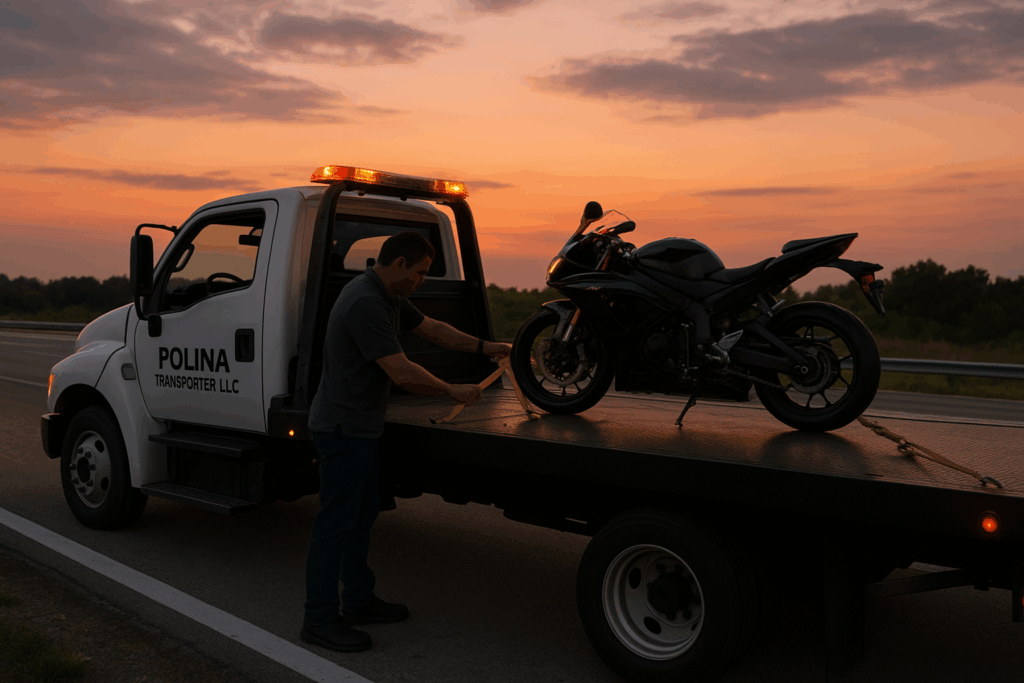
Motorcycles are compact but delicate to transport: suspension, fairings, mirrors and handlebars can be damaged during a careless load. For bike towing or accident recovery, the correct combination of a secure wheel chock and properly applied soft straps prevents tipping, rolling, and suspension damage during transit. Professional securement lowers repair claims and speeds up recovery.
Key point: Proper securement saves time, money, and stress — for you and the towing company.
2 — Accident Towing recovery — what it really means
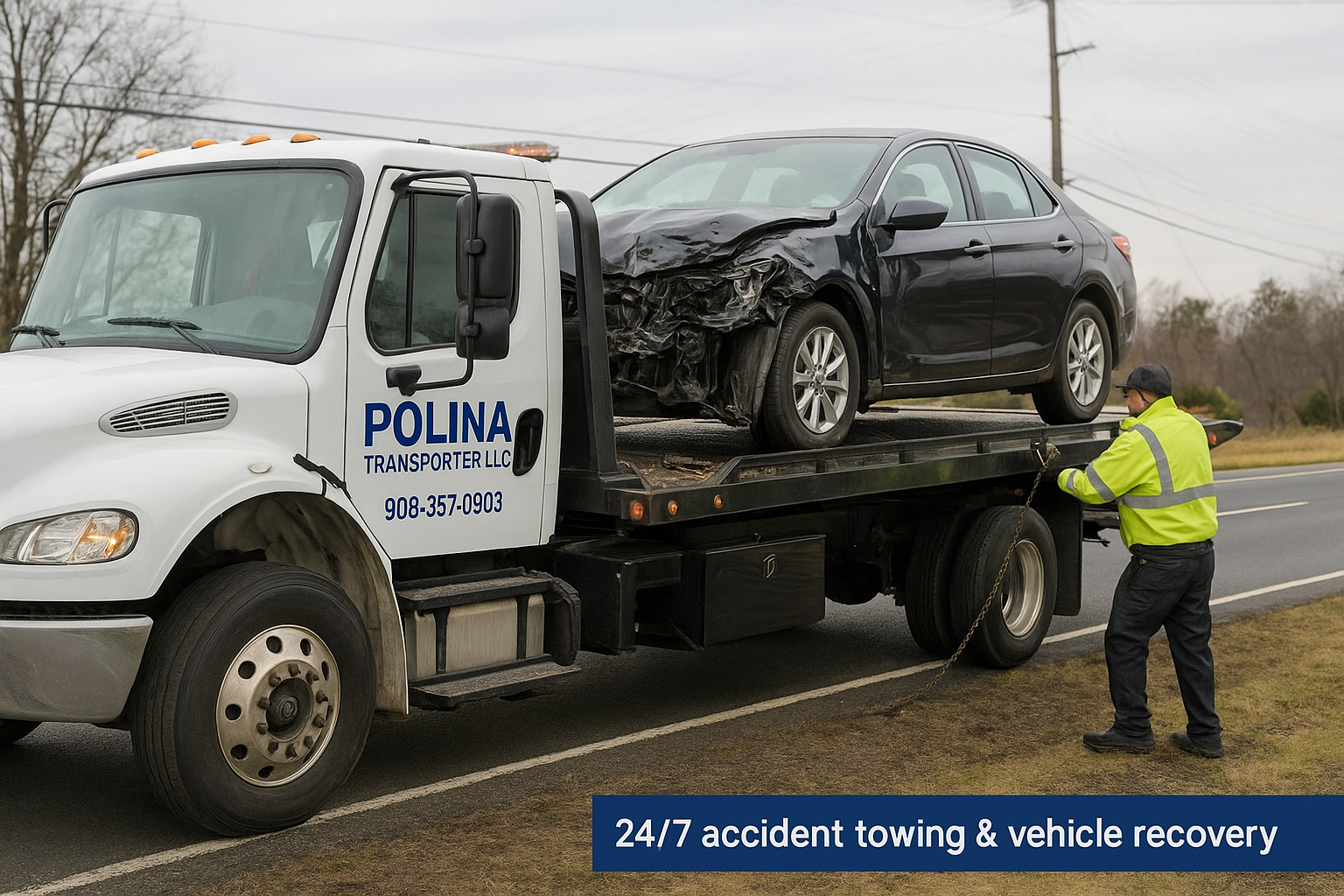
When we say Accident Towing recovery, we mean the complete service after a crash or mechanical failure: safe on-scene stabilization, loading, securement for transit, and delivery to the chosen destination (repair shop, impound, or your address). This includes taking photos of vehicle condition, using wheel chocks, soft straps, and following state and federal securement rules so liability and damage risk are minimized. Polina Transporter LLC handles motorcycle-focused accident recovery throughout New Jersey and beyond.
(Throughout this article the phrase Accident Towing recovery refers to that full-service workflow.)
3 — Essential gear: wheel chock, soft straps, tie-downs, and more
Professional motorcycle securement uses a small kit of proven gear:
- Wheel chock — anchors the front wheel and prevents forward/backward movement during braking and acceleration. A good chock keeps the bike vertical without relying on the kickstand.
- Soft straps (soft loops) — these loop around solid points on the bike (triple tree, frame, subframe) to distribute load and protect paint and chrome. Avoid attaching straps to footpegs or axles.
- Ratchet or cam straps — provide consistent tension; pros use the minimal tension needed to keep the bike upright without compressing the suspension excessively.
- Edge protection & padding — prevents straps from cutting into fairings or seat material.
- Flatbed with anchor points — a smooth bed and well-placed anchor points reduce movement and make four-point securement straightforward.
- Wheel chock — anchors the front wheel and prevents forward/backward movement during braking and acceleration. A good chock keeps the bike vertical without relying on the kickstand.
4 — Step-by-step securement process used by pros
Here’s the technician-level sequence a trained recovery crew follows when performing Accident Towing recovery on a motorcycle:
- Scene safety & stabilization — park safely, set cones, and use hazard lights. Photograph the bike’s pre-load condition for record-keeping.
- Pre-load inspection — check for leaking fluids, loose parts, suspect frame damage; document anything fragile.
- Load onto flatbed — use a ramp or winch for disabled bikes; position the front wheel into a wheel chock.
- Soft loop placement — loop soft straps around recommended points (triple tree, subframe) to avoid cosmetic damage.
- Four-point tie-down — use two straps in front (left/right) and two at the rear or subframe; tighten evenly and avoid over-compressing suspension (a light to moderate preload is the goal).
- Secondary security — use a third safeguard like a rear strap or block chocks to prevent lateral movement for long hauls.
- Final check & documentation — walk around, verify straps are secure and not rubbing sharp edges, log the tow and estimated arrival time.
A professional crew will re-check strap tension during longer trips and whenever stops are made.
5 — Regulations and safety standards you should know
Towing companies that operate across town or interstate must comply with federal cargo securement rules and local state requirements:
- Federal cargo securement rules require that cargo — including motorcycles on commercial carriers — be secured to prevent shifting during travel; 49 CFR addresses prevention of shifting and the need for securement systems that match the load.
- The FMCSA and related guidance set minimum strength and securement requirements (for example, aggregate working load limits and use of adequate tie-downs) that carriers must follow.
- New Jersey has towing minimum standards and vendor expectations for tows requested by law enforcement and public agencies; local ordinances also regulate private-property towing, fees, and consent rules. Professional companies are familiar with those requirements.
What this means for you: hire a carrier that documents its compliance (insured, uses rated straps and chocks, follows FMCSA/49 CFR guidance) to reduce risk.
6 — Pricing and job variables for motorcycle tows
Several factors influence cost when you call for motorcycle towing NJ or Accident Towing recovery:
- Distance & destination — short local moves are less than interstate or long-distance recovery.
- Condition of bike — a running motorcycle is cheaper to load than a heavily damaged one requiring winch, crane, or extra labor.
- Time of day & location — late-night or highway shoulder recoveries often carry higher call-out fees.
- Special handling needs — classic bikes, custom frames, or expensive fairings warrant flatbed + additional padding, which increases cost.
Tip: ask for a transparent breakdown (base fee, per-mile, special equipment) before authorizing service.
7 — What to ask your towing company (before they arrive)
Before the crew shows up, these quick questions will give you confidence:
- Do you use wheel chocks and soft straps for motorcycles?
- Are your technicians trained in Accident Towing recovery for bikes?
- What is your ETA and when will you perform a re-check during transit?
- Are photos and a damage log created at pickup?
- Are you insured to transport a motorcycle to an out-of-state repair shop?
Polina Transporter LLC includes these practices in our standard workflow — and we post clear pickup documentation on every job.
8 — Helpful enhancements
Use this short checklist if your bike needs recovery:
- Remove loose luggage or accessories if possible.
- Keep keys and title/registration available.
- Note any pre-existing cosmetic damage (take photos).
- Ask for flatbed + wheel chock for best protection.
- Save Polina Transporter LLC: polinatransporterllc.com and have their number ready.
Quick tip: If you ride a classic or high-value bike, request “no-compression” securement — this means the straps are tightened to keep the bike upright but not compress the forks or rear shock more than necessary.
9 — Related reading & next actions
- How wheel chocks work and why each bike needs the right one.
- Motorcycle tie-down best practices (soft straps, cam buckles, four-point setups).
- FMCSA cargo securement overview—what carriers must follow.
Next action: If you need immediate motorcycle recovery or advice about a recent accident, visit polinatransporterllc.com or call Polina Transporter LLC — tell dispatch you need motorcycle secure transport and ask for a flatbed with wheel chock.
10 — FAQ
Q: Is it safe to tow a motorcycle on a pickup truck bed?
Q: Do straps damage the bike?
Q: How do accident scenes change the handling of a motorcycle tow?
11 — Author & review box
Author:
Recovery Specialist — Polina Transporter LLC
10 years coordinating motorcycle and vehicle recovery across New Jersey, with hands-on experience in highway accident recoveries and securement protocols.
Reviewed by:
Operations Manager — Polina Transporter LLC
Certified in roadside safety procedures and DOT/fleet compliance.
11 — Author & review box
- FMCSA — Cargo Securement Rules (federal guidance on load securement).
- New Jersey State Police — Towing Minimum Requirements (state vendor/contract guidance).
- Lock ‘n Load — Guide to Motorcycle Wheel Chocks.
- RatchetStraps.com — Motorcycle Tie Down Securement Guide.
- TowTruckDriverTraining — Loading techniques for motorcycles & trikes.
Final notes & call to action
If you’re facing a bike breakdown or need Accident Towing recovery, choose a provider that documents the pickup, uses wheel chocks and soft straps, and follows cargo securement rules for interstate and local transport. For reliable motorcycle towing in New Jersey, visit polinatransporterllc.com or call Polina Transporter LLC — we specialize in safe bike handling, securement and timely delivery.